ESG Data Collection Doesn't Have to Be Spreadsheet Chaos
Discover how leading reporting teams move from fragmented ESG data collection to a structured, auditable workflow. Watch our new on-demand demo to see the process in action.
43 minutes • Free access • No live scheduling required
Companies don't struggle with ESG reporting because writing the report is difficult.
They struggle because collecting the underlying data is.
By the time sustainability teams start writing disclosures, dozens—or sometimes hundreds—of people have already been involved. Finance. HR. Procurement. Facilities. Risk. Operations. External suppliers. Every department owns a small piece of the puzzle.
Unfortunately, the process often looks something like this:
- Endless Excel files
- Email chains with missing attachments
- Different versions of the same metric
- Manual reminders
- Last-minute reconciliations
- Little visibility into progress
- Limited audit trail
The report becomes the easy part.
Getting trustworthy data ready for that report is where most of the work happens. This challenge is exactly why we built Tangelo ESG Collect.
ESG Reporting Starts Long Before You Write the Report
Many ESG software solutions focus on disclosures. They help you produce a report once the data already exists. But before reporting comes an equally important process:
- determining which disclosures apply
- assigning responsibilities
- collecting evidence
- validating information
- monitoring progress
- assembling disclosure-ready data
This upstream workflow determines the quality of everything that follows. If the collection process is fragmented, the report will be too.
Five Steps to Structured ESG Data Collection
Tangelo ESG Collect transforms ESG data collection into a controlled workflow consisting of five connected stages.
1. Scope
Start by defining the scope of your ESG disclosures with ease. Tangelo ESG Collect supports ESRS (full and VSME), ISSB Standards, and local variants for Australia, Hong Kong, Singapore, and the UK — all maintained and updated by Tangelo. Each framework is delivered with its XBRL taxonomy for structured, detailed reporting and tagging.
- Access maintained standards and taxonomies - work directly with ESRS, ISSB Standards, and local variants (AU, HK, SG, UK), always up to date.
- Extend with entity-specific items - add your own disclosures and dimensions, including typed dimensions where applicable.
- Record materiality decisions - capture the outcome of your (double) materiality analysis to define what’s in scope.
Materiality decisions can be documented directly within the platform, creating a clear foundation for the reporting process.
2. Plan
Once the reporting scope is defined, disclosures become structured data collection tasks. With ESG Collect you can define and group tasks, assign contributors, and set timelines — with flexibility to determine data granularity and carry content forward between reporting periods.
- Define data collection tasks – group disclosure items into tasks, assign owners, and set deadlines
- Apply dimensions and breakdowns – collect the right level of detail using standard or custom dimensions (e.g., country, gender)
- Support multiple periods – collect data monthly, quarterly, or annually, with roll-forward between reporting periods.
Instead of chasing contributors through email, everyone knows exactly what information they're responsible for.
3. Capture
Make it easy for contributors to provide the right information — whether quantitative or narrative. Data can be entered directly in the system, uploaded via spreadsheets, or connected through integrations, with full visibility of prior reporting periods.
- Provide data and evidence – complete assigned tasks, attach supporting files, and create typed dimensions where needed.
- Use Excel templates – generate spreadsheets for bulk data entry, then upload for fast population.
- Write narrative disclosures – capture qualitative inputs alongside quantitative data within the same structured environment.
- Connect data sources – import data automatically from specialized systems (e.g., carbon disclosure platforms) via the hub functionality.
4. Track
One of the biggest frustrations in ESG reporting is simply knowing where everything stands. With ESG Collect you stay in control of your ESG data collection process. You can monitor task progress in real time, send automated reminders, and oversee reviews and sign-offs — while also tracking ESG performance across key topics and targets.
- Monitor task progress – see completions, bottlenecks, and status across contributors.
- Send automated reminders – keep the process on track with smart notifications.
- Oversee review and sign-off – manage approvals and maintain a full audit trail.
5. Assemble
Turn collected data into disclosure tables ready for both internal and external reporting. The guided builder applies the correct framework logic, dimensions, and reporting periods, with taxonomy links for automated tagging and audit trail data included by default when content flows into Tangelo.
- Build disclosure tables – create tables with structured data and chart inputs ready for reporting.
- Generate internal overviews – build tables for management reporting, dashboards, and validation.
- Push to Tangelo – synchronize tables, narrative content, and figures directly with your report.
8 Reasons to Use a Connected ESG Reporting Workflow
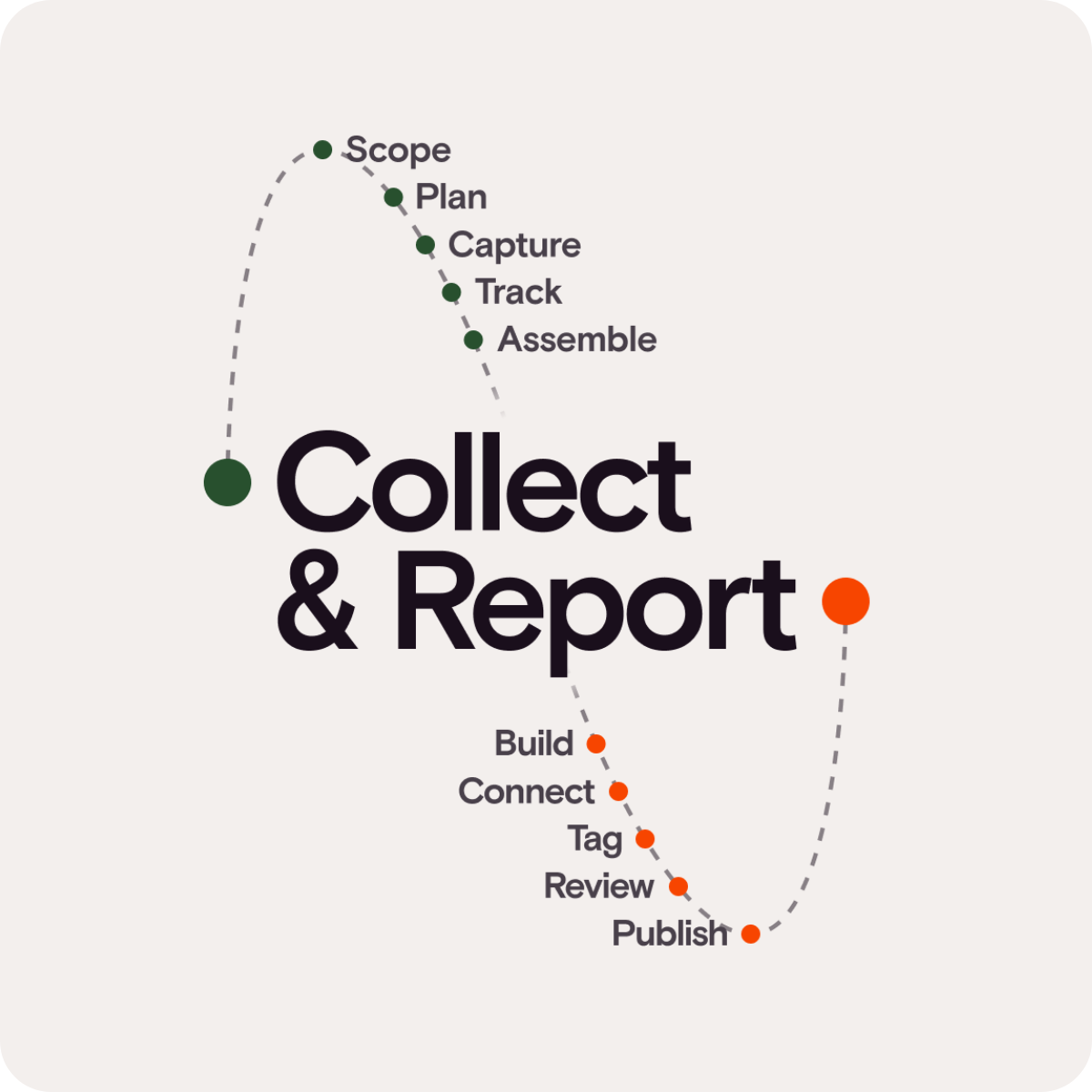 Unlike disconnected point solutions, Collect & Report is designed as one continuous workflow—from defining reporting requirements to publishing your final report. Every step builds on the last, preserving context, accountability and data integrity throughout the process.
1. Start with the Right Reporting Scope
Define exactly what needs to be reported based on the reporting frameworks relevant to your organization, including CSRD (ESRS), ISSB, VSME and other regional standards.
2. Turn Requirements into Actionable Plans
Translate disclosure requirements into structured data collection activities by assigning owners, setting deadlines, defining reporting periods and organizing work across teams.
3. Collect Data in a Controlled Environment
Capture quantitative metrics and narrative disclosures in one collaborative platform, complete with guidance, templates and supporting evidence.
4. Preserve Reporting Context from Day One
Framework mappings, metadata, tagging context and disclosure relationships remain connected to the data throughout the entire reporting process—eliminating manual rework later.
5. Keep Everyone Accountable
Monitor progress in real time with dashboards, automated reminders, review workflows and clear ownership for every disclosure and data request.
6. Maintain a Complete Audit Trail
Every update, approval and sign-off is recorded automatically, providing full transparency for internal governance and external assurance.
7. Move Seamlessly into Report Production
Assemble narrative and quantitative disclosures directly within the reporting environment, without exporting spreadsheets or manually transferring information between systems.
8. Publish with Confidence
When it's time to publish, your reporting data, supporting evidence and audit trail are already connected—giving finance and sustainability teams confidence that nothing has been lost along the way.
Watch the ESG Collect On-Demand Demo
Reading about a structured ESG workflow is one thing. Seeing it in action is another. In our new on-demand ESG Collect demo you'll see:
- how reporting scope is defined
- how collection tasks are planned
- how contributors provide information
- how progress is monitored
- how disclosure-ready data is assembled
- how the workflow connects seamlessly with Tangelo Report
43-minute in-depth walkthrough • Watch anytime • No live scheduling required
Latest resources

‘Prinsjesdag’: Proudly Powering the ‘Miljoenennota’ for 11 Years
We help power one of the Netherlands’ most important annual publications: the ‘Miljoenennota’ (Budget Memorandum) and related budget documents.
Revised ESRS: fewer datapoints, sharper decisions
Revised ESRS reduce datapoints but make materiality and judgement central.