Written for people, read by machines: what AI means for your annual report
The first reader of your annual report is increasingly not a person. According to PwC, 62% of investors now use AI to analyse company filings and earnings call transcripts, and only 4% say they do not use AI at all. Before an analyst forms a view, a model has often already read the report, extracted its claims and compared them with everything else the company has published.
That changes what a good report looks like. A document can be persuasive to a human reader and still be unclear to a machine. This article looks at what PwC found, how the other Big Four firms see the same shift, and what reporting teams can do about it.
What PwC found
PwC argues that AI reads in a fundamentally different way from people. In When AI becomes the reader, published in June 2026, the firm writes that AI "does not read in a linear manner. It processes text as data, identifying connections across large volumes of information." The piece draws on PwC's Global Investor Survey 2025 and on IOSCO's 2025 report on AI in capital markets.
The key distinction PwC makes is between signal and noise. Signal is what a model can identify and extract: "defined targets, metrics, quantified performance, or explicit links between strategy, risks and outcomes." Noise is "broad statements, inconsistent terms, or narratives not clearly linked to data or outcomes." PwC also notes that AI may misinterpret or overlook information conveyed through visuals, complex layouts, footnotes or linked documents.
The risk is sharpest in sustainability reporting. Where a model cannot reconcile narrative commitments with observable data, PwC writes, "the gap becomes visible", increasing exposure to perceived greenwashing.
PwC's recommendations for preparers:
- Use consistent terminology, clear headings, explicit assumptions and aligned metrics across all reports and communications.
- Test how AI interprets disclosures, using what PwC calls semantic stress testing and stakeholder persona review.
- Assign ownership for AI readiness and build interpretation testing into review and sign off.
- Use structured tagging such as XBRL and iXBRL, while recognising that tagging alone does not resolve ambiguity in footnotes and commentary.
What the other Big Four firms and researchers see
PwC is not alone. EY, KPMG, Deloitte, the global securities regulator IOSCO and academic research point in the same direction: machines are reading corporate reports at scale, on both sides of the table.
Source | Study | Sample | Finding |
EY | 2,000+ finance leaders, 815 institutional investors | 57% of investors believe AI could assess the credibility and accuracy of disclosures; 51% think it could identify discrepancies in them | |
EY | 350 investment decision makers | 85% say greenwashing is a greater problem than five years ago; 80% want better materiality and comparability | |
KPMG | 1,013 senior finance leaders, 20 countries | Over 75% use AI in financial planning, reporting and analysis; 36% name data quality and integration as the biggest opportunity | |
Deloitte | Expert view | Reports now carry a human readable and a machine readable layer; the move from PDF to web formats aids analysis and comparability | |
IOSCO | Regulators in 130+ jurisdictions | AI is used in investment research, sentiment analysis and surveillance; model and data quality is a key risk | |
NBER | US annual and quarterly filings | Machine downloads rose from 39% of all downloads in 2003 to 78% in 2016 |
EY's research shows investors expect AI to act as a credibility check. More than half believe it can test whether disclosures are accurate and spot discrepancies, precisely the gap between narrative and data that PwC warns about. EY also found that 96% of finance leaders worry about the reliability of nonfinancial data, with inconsistent data formats among the most cited problems.
KPMG's 2026 survey shows the same technology moving into the preparer's office. When AI drafts, checks and reads reports, the quality of the underlying data and structure becomes the deciding factor.
The academic evidence is older but telling. Researchers at the National Bureau of Economic Research found that companies with more machine readers already adapted their writing, making filings more machine readable. The same study found firms avoiding words that algorithms score as negative. That is a reminder that writing for machines should mean being clearer, not more cosmetic.
What this means for reporting teams
Taken together, the sources suggest that machine readability is no longer a technical afterthought. It is part of how a report is judged. Four practical implications follow.
- Consistency is credibility. The same metric should carry the same name, definition and value in the annual report, the sustainability statement, the press release and the investor presentation. Every inconsistency is a discrepancy a model can surface.
- Structure carries meaning. Clear headings, explicit links between strategy, risks and targets, and data presented as data rather than locked in images help a machine extract what matters.
- Narrative needs evidence. Commitments without quantified progress read as noise at best and as greenwashing at worst. EY's finding that 85% of investors see greenwashing as a growing problem shows how little benefit of the doubt remains.
- Tagging is necessary, not sufficient. ESEF and iXBRL make numbers machine readable, but PwC is clear that tagging does not remove ambiguity in footnotes, qualifications and commentary. The text itself must be precise.
None of this means writing for machines instead of people. A report that is consistent, well structured and backed by data is also easier for a board member, an analyst or a journalist to read.
Our perspective
At Tangelo we have helped listed companies, ministries and public institutions produce more than 40,000 reports. What we see matches what PwC and its peers describe: the hardest part of reporting is rarely the writing. It is keeping text, figures and definitions aligned across every chapter, every version and every output.
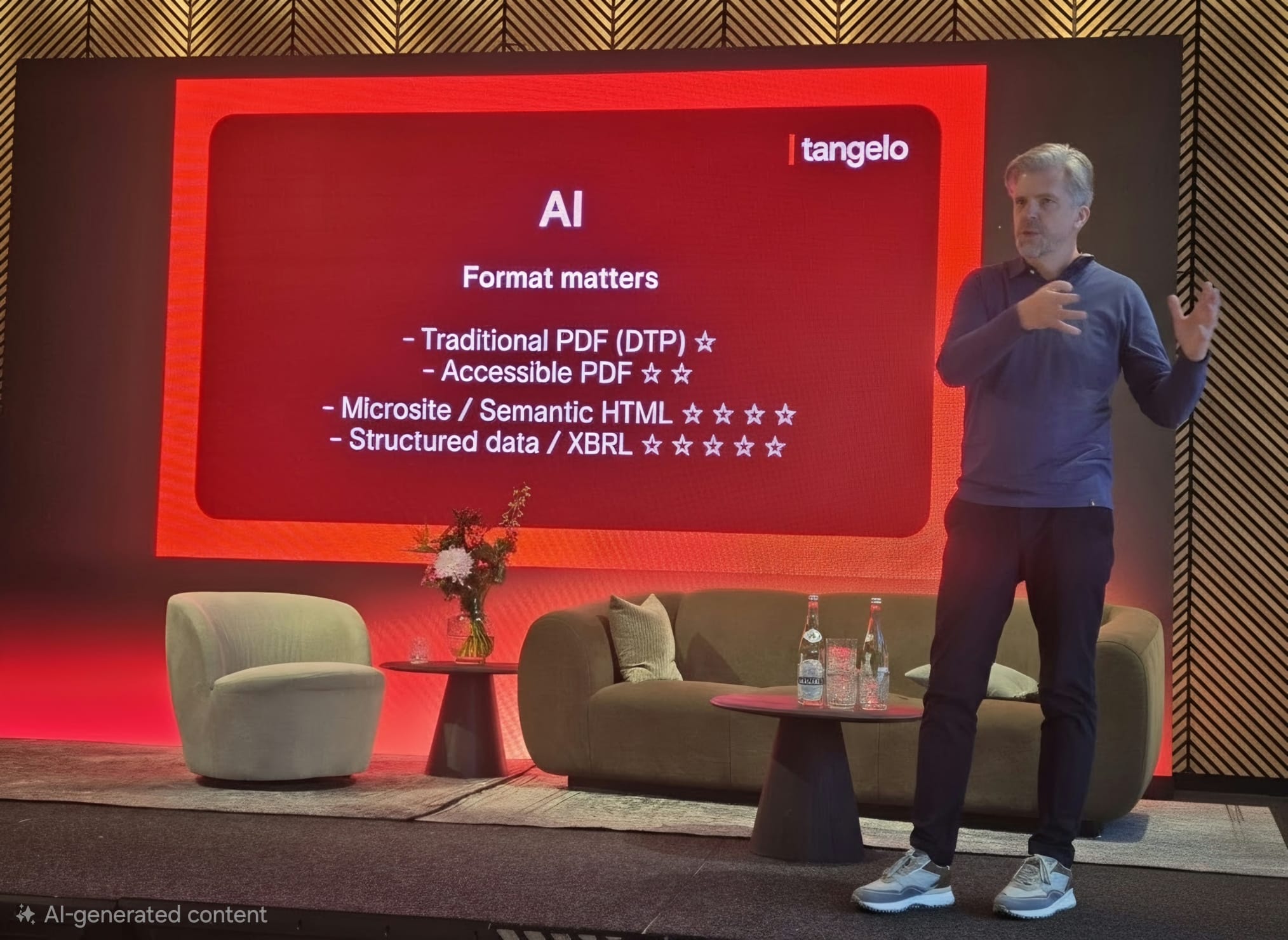
In our whitepaper AI and Investor Relations: From Controlling the Message to Shaping the AI Lens we looked at a question the Big Four leave largely open: how much does the publication format itself determine what AI makes of a report? The answer is a great deal. A regular PDF lets AI quote text, but it may misread which section a number belongs to or misinterpret a table. An ESEF filing created by converting the designed PDF carries tagged figures, yet loses the headings and notes that give them meaning.
Format | Structure | XBRL in file | AI reliability |
Regular PDF | Minimal | None | Mixed |
Accessible PDF (PDF/UA) | Tagged headings, tables, reading order | None | Good |
ESEF from converted PDF | Weak, positioned layout | Present, context often lost | Mixed |
ESEF with semantic XHTML | Real headings, lists and tables | High fidelity | Strong |
Microsite | High, if built accessibly | Links to filings, data downloads | Strong |
This is the practical side of PwC's point that tagging alone is not enough. Tags tell a machine what a number is; structure tells it what the number means. For IR teams, the task is no longer only to control the message, but to shape the lens through which AI retells it.
That is where AI readiness begins. When a report is built from one controlled source of content and data, the same figure appears the same way in the accessible PDF, the microsite and the ESEF filing. With Tangelo ESG Collect and the Tangelo Reporting Platform working together, sustainability data flows from collection to publication without being retyped along the way. Secure AI assistance for drafting and reviewing stays inside the platform, so unpublished figures never leave it. That leaves fewer gaps for a human or a machine to find.
PwC closes its article with a simple point: the only defensible stance is to be clear and consistent about strategy, performance and the choices behind them. We agree. The reader may be changing, but the standard is the same as it has always been.
What does AI mean for your reporting team?
Watch Erwin Groenendal, Co-founder of Tangelo Software, at CFO Benelux as he explores how regulation, digitalization and AI are changing corporate reporting, and why compliance is only part of the picture.
Want to bring AI into your own reporting process?